        |
|
| The Transition to Digital Cable Ready: Analysis & Forecasts | ||
| Product Type: Industry Analysis, Strategy, Forecast Release Date: Sept 2005 Author: Gary Sasaki Executive Editor: Michael Greeson Publisher: TDG Research Pages: 151 Figures: 72 Price: $1,495 |
| |
"Digital Cable Ready" is not your father's "Cable Ready". The public has only seen the tip of the iceberg. This report explains why, including the technology, markets, consumer awareness and forecasts.
Some may remember when analog cable services required some form of set-top box (STB). After "Cable Ready" televisions and video tape appeared, the standalone STB began to fade away. However, when the next generation of digital TV services appeared, the STB re-emerged as an important component. Put plainly, TVs were always one generation behind the pay TV service providers, thus requiring a STB to enable the "latest and greatest" TV experience.
As the TV industry moves towards a "Digital Cable Ready" (DCR) environment, the role of the STB is changing yet again. But this transition is not as simple as the earlier analog transition. Digital cable, driven by a need to compete against satellite services and (soon enough) IPTV services, is tossing in all kinds of new features and services. To enable these new services the industry is moving through several other transitions almost simultaneously.
Simply stated, the challenges of evolving to "Digital Cable Ready" are an order of magnitude more complex than the transition from analog to digital cable – a complexity certainly to be reflected in consumer confusion and uncertainty.
Therefore, understanding the larger ecosystem is vital: any company hoping to compete will likely have to manage more than one battleground.
This report seeks to answer those questions by providing a clear overview of the transition, layering in extensive consumer data from a recent survey of 2,100 households, and forecasting the growth of the DCR market.
Table of Contents
Key Findings
1.0 The Battlegrounds
2.0 Cable Industry Subscribers 2.1 North America 2.1.1 The United States 2.1.2 Canada 2.2 EMEA - Europe, Middle East, and Northern Africa 2.3 Asia and Australia 2.4 Latin America
3.0 An Architectural View 3.1 Conditional Access 3.1.1 Separable Security - the Emergence of CableCARD 3.1.2 How the CableCARD works 3.1.3 Overlay Infrastructure Systems 3.2 Interactive Services 3.2.1 Interactive Program Guide (IPG) 3.2.2 Impulse Pay Per View (IPPV) 3.2.3 Video On Demand (VOD 3.2.4 Parental Controls 3.2.5 Digital Video Recorder (DVR) 3.2.6 Interactive Television (iTV) 3.3 OpenCable Application Platform (OCAP) 3.3.1 Application Type 3.3.2 The Monitor Application 3.3.3 Application Examples 3.3.4 OCAP and CableCARD 3.3.5 OCAP DVR Extension 3.3.6 OCAP Home Networking Extension 3.3.7 OCAP and South Korea 3.3.8 Pluses and Minuses 3.4 Expanding HDTV Content 3.5 Next Generation Network Architecture (NGNA) 3.5.1 Accelerating the Digital Transition via Digital Simulcast 3.5.2 Switched Digital Broadcasting 3.5.3 1 GHz Plant 3.6 The Tuner 3.6.1 Digital Tuner Mandate 3.6.2 Tuner Design for ATSC/SCTE 3.7 European DVB 3.7.1 DVB Conditional Access (DVBCA) 3.7.2 Conditional Access Comparison 3.7.3 Multimedia Home Platform 3.8 Japanese Cable 3.8.1 Conditional Access 3.8.2 Interactive TV
4.0 Cable Industry Issues 4.1 The MSO and CableCARD World 4.1.1 Pricing 4.1.2 Provisioning Process 4.1.3 The Issue of Legacy CableCARD Hosts 4.2 The STB World 4.2.1 Why the US STB Market Won't Go Away 4.2.2 Why the U.S. STB Eventually Goes Away 4.2.3 Strategies for U.S. STB Manufacturers 4.2.4 Comcast/Motorola, Comcast/Cox 4.2.5 DVB-C STB World 4.2.6 STB Manufacturers
5.0 The Consumer Electronics World 5.1 Opportunities and Threats 5.2 What is True "Digital Cable Ready"? 5.2.1 FCC Defines Digital Cable Ready 5.3 Product Verification 5.4 CableCARDs in Devices 5.4.1 The Television 5.4.2 The DVR 5.4.3 The PC
6.0 Consumer View 6.1 Methodology 6.2 General Preferences 6.3 CableCARD Awareness 6.4 Perceived CableCARD Benefits 6.4.1 Saving STB Space 6.4.2 Getting Rid of Cables 6.5 Provisioning 6.6 Interactive Services
7.0 Analysis & Forecasts 7.1 The Timeline for Market Drivers 7.2 DTV Demand Analysis 7.2.1 Average Retail Pricing Trends 7.2.2 DTV Unit Projections 7.3 Digital Video Recorders 7.4 Digital Cable Adoption 7.4.1 Digital Simulcast Deployment 7.5 Conditional Access 7.5.1 CableCARD Deployments 7.5.2 Downloadable Security Deployments 7.5.3 Set Top Boxes with Separable Security 7.5.4 Summary Unit Volumes
Appendix - Tale of a CableCARD Appendix B - Survey Details Appendix C - US Cable TV Operators Glossary
List of Figures
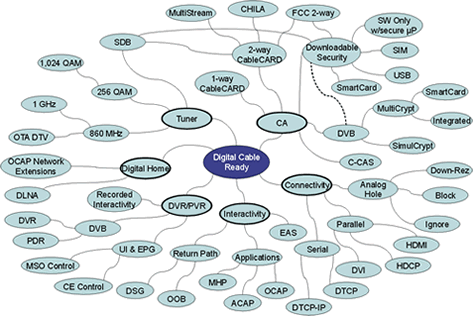
Figure 1 - Short-Term Cable Companies Battlegrounds Figure 2 - Comparison of U.S. DBS, Digital Cable, All Cable, and Total TV Households Figure 3 - Top Ten MSOs: Digital Cable vs. Total Cable Television Subscribers Figure 4 - Top Six U.S. MSOs Subscribers 2004: TV, Digital TV, Internet and Voice Figure 5 - Top Three Canadian Cable Companies, 2004 - Subscribers, Digital Cable and Internet Figure 6 - Digital TV, Internet & Voice Subscribers among Major European Cable Operators, 2004 Figure 7 - European Cable Company Subscribers 2004: Homes Passed, TV, Digital TV, Internet and Voice Figure 8 - Estimates of Television and Cable households for Major Asian Countries and Australia in 2003/2004 Figure 9 - Top Ten MSOs in South America by Subscribers, 2004 Figure 10 - Major Latin America Countries: Television Households, Cable and Satellite Subscribers (2002) Figure 11 - Simplified HFC Cable Plant Figure 12 - CableCARD Examples: Scientific Atlanta and Motorola Figure 13 - Digital Cable Ready Logo Figure 14 - SmartCard, SIM Card, SoC Security Figure 15 - Head End, Host, and CableCARD Block Diagram Figure 16 - Encryption Mode Indicator (EMI) Modes Figure 17 - General CA Overlay Scheme Figure 18 - Examples of PSIP Data Types Figure 19 - E-Bay on TV Figure 20 - Simplified OCAP Architecture Figure 21 - OCAP Application Examples Figure 22 - Current Cable HDTV Programming Offered in HDTV Figure 23 - Modular CMTS and Edge QAM Figure 24 - Cable Frequency Allocation Figure 25 - FCC Digital Tuner Timing Figure 26 - Simplified Tuner Block Diagram Figure 27 - DVB Cable around the World Figure 28 - Conditional Access Module and SmartCard (Conax) Figure 29 - Conax Content Voucher Figure 30 - Comparison of Different Approaches to Conditional Access Figure 31 - Conditional Access vendors for CAM (DVB) and POD (CableCARD) Figure 32 - Japan's B-CAS and C-CAS Cards Figure 33 - Accumulated Number of CableCARDs Deployed to US Subscribers Figure 34 - STB and CableCARD Rates for Top Ten US MSOs Figure 35 - List of Cable Set Top Box Manufacturers Figure 36 - Digital Cable Ready Issues Tree Figure 37 - Number and Brand of Products CableCARD Verified as of July 2005 Figure 38 - Pay TV Subscriptions Figure 39 - Viewership of Specific TV Programming Figure 40 - Date of Most Recent TV Purchase by Age Figure 41 - Planned Date of Next TV Purchase, by Age Figure 42 - Interest in Purchasing an SDTV, HDTV or DVR in the Next Six Months, by Age Figure 43 - CableCARD Awareness by Date of Most Recent TV Purchase Figure 44 - CableCARD Awareness among Those Likely to Purchase a TV Figure 45 - CableCARD Awareness by Type of Television Service Figure 46 - CableCARD Awareness by Income Level Figure 47 - Perceived Benefit of Saving Space if Using a CableCARD-Enabled TV CableCARD Figure 49 - Perceived Benefit of Having One Less Remote if Using the CableCARD Figure 51 - Provisioning Preference by Income Figure 52 - Ranking of Interactive Services Figure 53 - Ranking of Interactive Services among ESPN Viewers Figure 54 - Ranking of Interactive Services by Gender Figure 55 - Lack of Interest in Interactive Services by Age Figure 56 - Ranking of Interactive Services by Age Figure 57 - Projected Timeline for "Digital Cable Ready" Evolution Figure 58 - Average U.S. DTV Price Projection Figure 59 - Annual U.S. DTV/Monitor Sales (Units) - 2000 thru 2010 Figure 60 - Cumulative DTV and Monitors in the U.S. (Units) - 2000 thru 2010 Figure 61 - Annual Net U.S. DVR Households that Subscribe to Cable: 2004 - 2010 Figure 62 - Cumulative U.S. DVR Households that Subscribe to Cable TV: 2004 - 2010 Figure 63 - Annual and Cumulative U.S. DVR Households that Subscribe to Cable TV: 2004 - 2010 Figure 64 - Projected U.S. Digital Cable Subscribers Figure 65 - Projected U.S. Digital Simulcast & All-digital, Subscribers Passed Figure 66 - Annual U.S. CableCARD Deployments in Televisions and DVRs: 2006 - 2010 Figure 67 - Downloadable Security Deployments in US Televisions and DVRs: 2006- 2010 Figure 68 - Annual U.S. Deployments of Digital Cable STBs with Separable Security: 2007 - 2010 Figure 69 - Combined Forecast of U.S. CableCARD and Downloadable Security in Televisions and DVRs: 2006 - 2010 Figure 70 - Type of Internet Access Used by Survey Respondents Figure 71 - Gender of Survey Respondents Figure 72 - Income Levels of Survey Respondents Figure 73 - Top 25 U.S. Cable Companies Ranked by 2004 Subscribers | ||